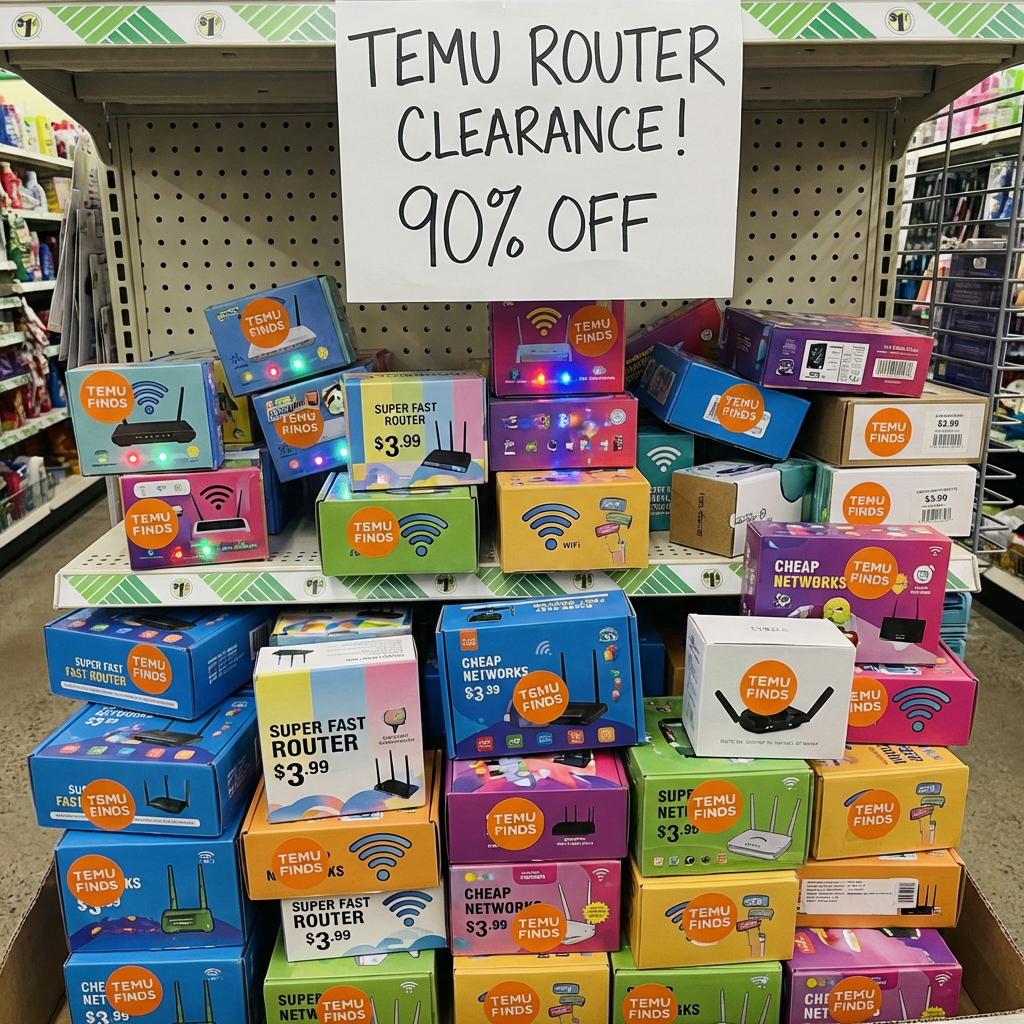
The contemporary e-commerce landscape is defined by a radical democratization of technology, where the barriers to entry for advanced digital infrastructure have been systematically dismantled by cross-border platforms such as Temu. This “direct-from-factory” model has catalyzed a phenomenon where consumers can acquire Wi-Fi 6 routers, signal extenders, and 4G LTE hotspots for prices as low as $5 to $17.1 While this presents a facade of economic empowerment—encapsulated by the marketing slogan “Shop like a billionaire”—it masks a profound and systemic risk profile.4 The proliferation of these ultra-low-cost devices occurs at a historical inflection point where the domestic network has become a vital extension of the national critical infrastructure, primarily due to the ubiquitous adoption of remote work.5 The integration of networking hardware that is “born insecure” into this environment establishes a decentralized network of potential entry points for state-sponsored threat actors and criminal enterprises, facilitated by documented surreptitious data harvesting via associated mobile applications, a systemic absence of security maintenance, and hardware-level vulnerabilities.7
The Commodity Networking Ecosystem: Analyzing the Temu Hardware Catalog
The inventory of networking equipment available on Temu and its sister platforms is characterized by a bifurcated market of certified refurbished units from established brands and a vast ocean of unbranded, white-label devices primarily originating from the industrial corridors of Shenzhen, China.1 The pricing architecture for these devices is so aggressive that it disrupts traditional retail benchmarks, often selling hardware for less than the cost of the raw components used in Western-designed equivalents.11
Strategic Classification of Consumer Networking Assets
The market for budget networking gear is segmented into several distinct tiers, each presenting unique technical and security challenges. The following table provides a structural overview of the representative equipment currently dominating the high-volume sales categories on the platform.
| Device Category | Representative Pricing | Primary Technical Features | Identified Limitations and Risks |
| Ultra-Budget Wi-Fi 6 Router | $6.00 – $17.44 | 300Mbps to 1200Mbps, 4-6 Antennas, WPA3 support 1 | Limited flash memory (16MB), lack of persistent firmware update paths, generic Linux-based SoCs 9 |
| Signal Repeaters / Extenders | $2.59 – $8.17 | 2.4GHz/5GHz Dual-band, USB-powered, 300Mbps to 1200Mbps 2 | Potential for “dummy” hardware (night lights disguised as extenders), unsecured management portals 15 |
| Portable 4G LTE Hotspots | $28.09 – $61.50 | 6000mAh battery, International SIM support, 150Mbps 1 | Obfuscated data routing, hardware-level backdoors, vulnerability to SIM swap and tracking 17 |
| Mesh Wi-Fi Systems | $139.00 – $268.46 | Multi-node coverage (5,000+ sq. ft.), Wi-Fi 6/7 protocols 1 | Dependency on Chinese-hosted cloud controllers, susceptibility to “Living off the Land” exploits 20 |
| Managed Networking Components | $12.46 – $19.17 | SFP Optical Transceivers, Gigabit Ethernet Adapters 2 | Unsigned drivers, potential for unauthorized local code execution through peripheral interfaces 2 |
The technical reality of a $6 Wi-Fi 6 router is often at odds with its marketed specifications. Forensic analysis and teardowns of similar ultra-budget electronics indicate that the extreme cost compression is achieved through the use of salvaged or substandard components.12 For instance, a “10,000mAh” power bank was found to contain salvaged batteries with signs of damage and physical debris, such as lumps of steel, added to simulate the weight of a higher-capacity unit.12 In the context of networking, this translates to devices with minimal memory—often as low as 16MB of flash—which precludes the installation of modern, secure operating systems or the implementation of robust encryption protocols.14
Forensic Analysis of the Temu Ecosystem: Data Harvesting and Privacy Violations
The risks associated with budget networking hardware are intrinsically linked to the digital ecosystem that supports them. Most unbranded routers and extenders available on Temu require the use of a proprietary mobile application for setup and management. These applications, and the primary Temu platform itself, have been the subject of extensive forensic investigations by state authorities and independent cybersecurity firms.7
The Pinduoduo Legacy and Engineering Overlap
The architectural foundations of the Temu platform are deeply rooted in its sister application, Pinduoduo, which was suspended from the Google Play Store in 2023 after being identified as containing highly sophisticated malware.4 Investigations by the State of Texas reveal a direct continuity in the development teams, with PDD Holdings reportedly transferring a 100-member team of engineers and project managers from the Pinduoduo platform to the Temu project.7 This transition is significant because the exploits developed for Pinduoduo were designed to bypass mobile security protocols and gain unauthorized access to user data.7
Code-Level Allegations: The Trojan Horse Model
Forensic experts have identified eighteen software functions within the Temu application that are characterized as “completely inappropriate” for a standard e-commerce retailer.7 These functions transform the application into a digital “tick” or parasite that is extremely difficult to remove once it has established a foothold on a device.4
| Forensic Finding | Mechanism of Action | Cybersecurity Implication |
| Dynamic Code Loading | Use of get.Runtime.exec(); to perform “package compile” 7 | Allows the app to download and execute new programs on-the-fly, bypassing app store security reviews 24 |
| Log and System Access | Requesting logs from /system/bin/logcat 7 | Enables the monitoring of system-level activity and the identification of other installed applications 23 |
| Obfuscated Encryption | Proprietary encryption layers added over HTTPS 24 | Shields network traffic from analysis by security tools, hiding where data is being sent 24 |
| Hardware Scanning | Extraction of MAC addresses and Wi-Fi state 7 | Allows for precise movement tracking and mapping of a user’s domestic and professional networks 23 |
| Manifest Omissions | Hiding permissions like CAMERA and RECORD_AUDIO 7 | Misleads users and OS security monitors about the app’s actual data access capabilities 7 |
The implication of these findings is that the application serves as a persistent “backdoor” into the user’s private data.7 By referencing EXTERNAL_STORAGE, the app can access and exfiltrate a user’s images, chat logs, and content from other applications.7 The combination of precise location tracking (within 10 feet) and Wi-Fi mapping allows the platform to build a comprehensive profile of a user’s travels and associations, which is then stored on servers subject to Chinese jurisdiction.23
National Security and the Weaponization of the Domestic Network
The mass adoption of insecure networking equipment establishes a strategic vulnerability that extends beyond individual privacy to the level of national security. The United States government has identified consumer routers as a primary vector for state-sponsored cyber-espionage and the pre-positioning of destructive capabilities within critical infrastructure.8
Volt Typhoon and the Strategy of Pre-Positioning
The state-sponsored hacking group known as Volt Typhoon, linked to the People’s Republic of China (PRC), has systematically compromised hundreds of small office and home office (SOHO) routers to hide their tracks while targeting American energy, transportation, and water sectors.20 The objective of these operations is not immediate intelligence gathering but rather the establishment of a “covert foothold” that can be activated to disrupt essential services during a future geopolitical crisis or conflict.20
Volt Typhoon’s primary tool for this activity is the KV Botnet, which infects vulnerable routers—often those that are “end-of-life” or lack modern security hardening.20 The influx of $6 routers from Temu significantly expands the attack surface for these actors. Because these devices are built with minimal security oversight and often utilize generic, vulnerable firmware, they are effectively “pre-compromised” assets that can be easily integrated into malicious botnet infrastructures.9
The Industrialization of IoT Exploitation: Raptor Train and w8510.com
The “Raptor Train” botnet, identified by the command-and-control (C2) domain w8510.com, represents an unprecedented escalation in the scale and sophistication of IoT-based operations.27 This botnet, managed by the PRC-based Integrity Technology Group, has at times controlled over 260,000 devices, including routers, IP cameras, and NAS systems.27
The operations of Raptor Train are characterized by a highly structured hierarchical system:
- Tier 1 Nodes: These are the compromised consumer devices (routers and IoT endpoints) that serve as the front line of the botnet. On average, these nodes power cycle and rotate every 17 days, making them difficult for traditional security tools to track.28
- Tier 2/3 C2 Servers: These management layers coordinate the activity of the Tier 1 nodes, facilitating large-scale exploitation campaigns such as the “Canary” and “Oriole” campaigns, which targeted specific vulnerabilities in routers and industrial equipment.28
The integration of ultra-budget hardware into domestic networks provides the “raw material” for these volumetric botnets. As residential networks are increasingly used to host proxies for state-sponsored traffic, the line between a civilian household and a national security asset becomes dangerously blurred.21
Technical Vulnerabilities: The Chipset and Firmware Architecture
The insecurity of budget networking hardware is a product of fundamental flaws in its underlying system architecture. Most of these devices utilize low-cost system-on-chip (SoC) solutions from manufacturers like MediaTek, which have recently been the subject of critical security disclosures.30
Critical Exploit Analysis: CVE-2024-20017
In 2024, a critical zero-click vulnerability (CVE-2024-20017) was discovered in MediaTek Wi-Fi chipsets (including the MT7622 and MT7915 series) widely used in both branded and unbranded routers.30 This vulnerability, which carries a CVSS score of 9.8, exists within the wappd network daemon responsible for managing wireless interfaces and Hotspot 2.0 technologies.30
The exploit mechanism involves an out-of-bounds write issue where a length value taken directly from attacker-controlled packet data is used without bounds checking.30 This allows an attacker to trigger a stack buffer overflow and execute arbitrary commands, such as establishing a reverse shell using built-in tools like Bash or Netcat.30 Because many budget routers lack automated update mechanisms, these vulnerabilities can persist indefinitely, providing a permanent entry point for anyone within Wi-Fi range or across the internet if the management interface is exposed.30
The “Leftover Debug Code” Problem
A recurring theme in the analysis of Chinese-manufactured networking equipment is the presence of residual debug code and intentional backdoors. Researchers have identified hidden functionalities in brands like Wavlink and Jetstream that permit unauthorized root access.18 In some instances, the patching process itself is flawed; TP-Link’s attempt to fix CVE-2024-21827 (a leftover debug code vulnerability) left the debug functionality accessible through a new path, leading to the discovery of CVE-2025-7851.34 This systemic failure in the software development lifecycle indicates that security is often a secondary concern to manufacturing volume and speed-to-market.
The Geopolitical Context: Chinese National Intelligence Law
The security risks of Temu-sourced equipment cannot be fully understood without considering the legal and political environment of the People’s Republic of China. Under the National Intelligence Law, Chinese enterprises—regardless of where they operate—are obligated to cooperate with the state’s intelligence apparatus.4
The Secret Cooperation Mandate
This legal framework requires that companies maintain data in a manner that is accessible to Chinese authorities and participate in “national intelligence efforts” without disclosing such cooperation to the public or international partners.8 For an e-commerce platform like Temu, which collects vast swaths of personal identifiable information (PII) from millions of Americans, this creates an unprecedented vector for surveillance.7 The data collected from a $6 router’s management app—including network maps, connected device lists, and behavioral patterns—becomes a strategic asset for the CCP, enabling the identification of high-value targets (such as government employees or critical infrastructure personnel) within the civilian population.8
The Supply Chain Vulnerability
The FCC’s 2026 National Security Determination highlights that the United States has become dangerously dependent on foreign-produced routers, which dominate 96% of the domestic market for internet access.8 This dependency creates an “unacceptable economic and national security risk,” as compromised routers can enable in-depth network surveillance and unauthorized access to government and business networks.8 The move to ban these devices is a recognition that the “factory-to-home” pipeline serves as a built-in backdoor into the American digital landscape.36
Regulatory Response: The 2026 FCC Router Ban and the Covered List
On March 23, 2026, the Federal Communications Commission (FCC) officially updated its “Covered List” to include all foreign-produced consumer-grade routers.26 This move represents a paradigm shift in U.S. technology policy, moving from the targeting of specific companies to the categorical restriction of entire product classes based on their place of production.37
Scope and Impact of the March 2026 Action
The addition of foreign-produced routers to the Covered List is an extension of the logic used in the 2025 drone ban, recognizing that networking equipment is a critical component of national security.37
| Regulatory Parameter | Detail | Implication |
| Definition of Router | Consumer-grade networking devices primarily for residential use, installable by the customer 26 | Includes generic Wi-Fi routers, extenders, and mesh systems from platforms like Temu 26 |
| Scope of Production | Includes manufacturing, assembly, design, and development 26 | Affects any device with a Chinese engineering footprint, even if assembled in a third country like Vietnam 39 |
| Authorization Ban | Prohibition of new radiofrequency equipment authorizations 26 | New models produced abroad cannot be legally imported, marketed, or sold in the U.S. 37 |
| Security Updates | Blanket waiver issued until at least March 1, 2027 26 | Allows existing devices to receive security patches to prevent them from becoming permanent botnet nodes 37 |
| Exemptions | Conditional Approvals available for 18-month periods 37 | Manufacturers must prove their supply chain is “trusted” and transition toward domestic production 26 |
The immediate effect of this ban is to cripple the ultra-low-cost market on platforms like Temu. Without FCC authorization, new “off-brand” routers cannot enter the U.S. market, and existing authorized models face severe restrictions on modifications or software updates.26 This regulation forces a market-wide “cleansing” of the supply chain, as retailers are prohibited from selling non-compliant hardware once current stocks are exhausted.36
The “True Cost” of Cheap Networking Gear: Economic and Systemic Risks
The allure of the $6 router is based on a narrow view of cost that ignores the long-term systemic and economic consequences of deploying substandard hardware. In both domestic and professional contexts, the Total Cost of Ownership (TCO) for budget networking equipment far exceeds the initial investment.40
Total Cost of Ownership (TCO) Comparison
Quality networking solutions are often perceived as expensive because they include the cost of ongoing security research, automated patching, and robust technical support. Conversely, budget hardware externalizes these costs to the user and the broader internet ecosystem.
| Cost Component | Budget/Unbranded Router ($15) | Enterprise-Grade / US-Produced Router |
| Initial Capital Expenditure | Extremely Low ($5 – $30) | Moderate to High ($150 – $500+) |
| Operational Maintenance | High (Frequent reboots, manual updates, “dummy” hardware risk) 15 | Low (Automated firmware management, proactive health monitoring) 41 |
| Productivity Loss | 15–30 minutes/day per user due to latency/instability 40 | Minimal (Sustained gigabit performance and reliability) 41 |
| Security Risk Exposure | Critical (Lack of patches, potential for $10M+ breach cost) 9 | Managed (Regular security audits, CVE remediation, WPA3 implementation) 41 |
| Lifecycle Duration | 2–3 years (Often “born end-of-life”) 20 | 5–7 years (Continued support and feature updates) 40 |
The economic impact of a security breach facilitated by a compromised home router can be devastating. Small businesses, which often rely on employees’ home networks for remote access, face costs averaging $10,000 per incident for unplanned downtime and forensic response.42 Industrial IoT compromises, which can be triggered through a compromised domestic gateway, can result in recovery costs exceeding $10 million and significant reputational damage.9
The Remote Work Vulnerability Gap
The shift to remote work has “broken the security perimeter” that previously protected corporate assets.32 Home networks are now the weakest link in the global IT infrastructure, with routers representing over 50% of the most exploitable devices.32 Remote workers are three times more likely to accidentally expose sensitive data than their office-based colleagues, primarily because they are operating in an environment without IT oversight, using outdated or unmanaged hardware.5
This “Shadow IoT” problem—where unauthorized or unmanaged devices connect to corporate systems—creates an environment where malware can spread laterally from a $6 signal booster to a secure corporate server.44 The lack of segmentation in home networks means that a child’s toy or a cheap Wi-Fi repeater sits on the same subnet as a laptop accessing financial records or customer data, turning every weak device into a potential doorway for attackers.44
The Future of Networking Security: Towards a Trusted Supply Chain
The 2026 FCC ban marks the beginning of a larger movement to re-establish a trusted supply chain for critical digital infrastructure. The industry is currently undergoing a period of intense recalibration, characterized by the onshoring of manufacturing and the integration of advanced defense technologies.21
AI and Autonomous Defense
As botnets evolve to unleash multi-terabit floods in a matter of minutes, manual security playbooks are no longer sufficient.21 The future of network security lies in automated, AI-driven detection and mitigation systems that can identify and block malicious traffic at the edge.21 Manufacturers are increasingly focused on “Secure by Design” principles, ensuring that hardware includes hardware-based encryption, secure boot processes, and automated patching as base functionalities.40
Strategic Reshoring and the Cost of Trust
The mandate to move production away from foreign adversaries will inevitably increase the baseline cost of consumer electronics. Companies like TP-Link are already planning U.S.-based facilities to complement their operations in Vietnam, reflecting a broader trend of “friend-shoring” or domestic production.39 While this ends the era of the $6 router, it initiates a new era of digital resilience where the “true cost” of hardware includes the insurance of a secure and sovereign supply chain.8
Synthesis and Strategic Conclusions
The phenomenon of ultra-low-cost networking equipment available through platforms like Temu is a testament to the efficiency of modern global logistics, but it is also a stark warning of the vulnerabilities inherent in a globalized technology market. The evidence indicates that these devices are not merely affordable consumer goods but are strategic liabilities that undermine personal privacy, corporate security, and national stability.4
The integration of $6 routers into the domestic network establishes a persistent, surreptitious pipeline for data exfiltration, governed by foreign laws that mandate cooperation with state intelligence services.7 These devices serve as the building blocks for hyper-volumetric botnets capable of targeting the foundations of the national economy and critical infrastructure.20
The regulatory response initiated by the FCC in 2026 is a necessary corrective measure to re-secure the domestic digital perimeter.26 However, the responsibility for securing the network ultimately rests with the user and the organization. The transition toward a trusted supply chain requires a shift in perspective: from a focus on upfront savings to a comprehensive understanding of the Total Cost of Ownership and the strategic value of security.
For stakeholders ranging from individual consumers to national security policymakers, the path forward involves several critical imperatives:
- Immediate Decommissioning of Insecure Hardware: Any unbranded or ultra-budget networking device that lacks a clear, audited security update path should be removed from domestic networks, especially those used for professional purposes.20
- Adoption of Secure by Design Principles: Future hardware acquisitions must prioritize devices that offer hardware-based encryption, WPA3 support, and automated security management.32
- Strict Network Segmentation: Domestic networks must be segmented to isolate unmanaged IoT devices from sensitive professional and personal computers.6
- Supply Chain Auditing: Organizations must conduct comprehensive audits of their remote employees’ networking environments, identifying and mitigating the risks of foreign-produced hardware in compliance with the updated FCC Covered List.5
The era of the “disposable” router is coming to an end, replaced by a more nuanced understanding of the digital infrastructure as a vital, and vulnerable, national asset. Securing this infrastructure is not merely a technical challenge but a fundamental requirement for the preservation of privacy and security in a hyper-connected world.8
Works cited
- internet router sold on Temu United States, accessed April 2, 2026, https://www.temu.com/internet-router-s.html
- WIFI & Networking – Temu, accessed April 2, 2026, https://www.temu.com/c/wifi-networking-o4-1741.html
- TEMU Z04 Wi-Fi extender dual band • Unboxing, installation, configuration and test, accessed April 2, 2026, https://www.youtube.com/watch?v=wLLcomj9JOo
- Looking Beyond TikTok: The Risks of Temu – CSIS, accessed April 2, 2026, https://www.csis.org/analysis/looking-beyond-tiktok-risks-temu
- 18 Remote Working Security Risks in Business – SentinelOne, accessed April 2, 2026, https://www.sentinelone.com/cybersecurity-101/cybersecurity/remote-working-security-risks/
- The Impact of Remote Work on Security and Compliance – 360 Advanced, accessed April 2, 2026, https://360advanced.com/the-impact-of-remote-work-on-security-and-compliance/
- CAUSE NO. ______ THE STATE OF TEXAS … – Attorney General, accessed April 2, 2026, https://www.texasattorneygeneral.gov/sites/default/files/images/press/Petition_12.pdf
- National Security Determination on the Threat Posed by Routers Produced by Foreign – Federal Communications Commission, accessed April 2, 2026, https://www.fcc.gov/sites/default/files/NSD-Routers0326.pdf
- The Reality of IoT Security in 2025 and Our Solution – GAP, accessed April 2, 2026, https://www.growthaccelerationpartners.com/blog/52-hours-under-attack-the-reality-of-iot-security-in-mid-2025
- Who are you really buying from online? – Which? – Which.co.uk, accessed April 2, 2026, https://www.which.co.uk/news/article/who-are-you-really-buying-from-online-aYVeJ2k48qq8
- Is Temu safe? A complete guide to secure online shopping – Surfshark, accessed April 2, 2026, https://surfshark.com/blog/is-temu-safe
- I cracked open cheap charging gadgets from Temu – and it was worse than I expected, accessed April 2, 2026, https://www.zdnet.com/article/temu-charging-gadgets-teardown-safety-concerns/
- wireless router sold on Temu United States, accessed April 2, 2026, https://www.temu.com/wireless-router-s.html
- Cheaper from china but wrong language ? – Home Network Community, accessed April 2, 2026, https://community.tp-link.com/en/home/forum/topic/236228
- Temu (probably) Wifi Device? : r/wifi – Reddit, accessed April 2, 2026, https://www.reddit.com/r/wifi/comments/1hbyus0/temu_probably_wifi_device/
- Cheap Chinese wifi extender? Hacked? : r/techsupport – Reddit, accessed April 2, 2026, https://www.reddit.com/r/techsupport/comments/1k33e04/cheap_chinese_wifi_extender_hacked/
- FBI Warns of Data Security Risks From China-Made Mobile Apps – SecurityWeek, accessed April 2, 2026, https://www.securityweek.com/fbi-warns-of-data-security-risks-from-china-made-mobile-apps/
- Andrew Horton, accessed April 2, 2026, https://2631050.fs1.hubspotusercontent-na1.net/hubfs/2631050/Andrew%20Horton-1.pdf
- wifi 6 mesh wifi – Temu, accessed April 2, 2026, https://www.temu.com/-wifi-6-mesh-wifi—-deco-x60-covers-up-to-5000-sq-replaces–and-extenders-2-pack-g-602672342077564.html
- Office of Public Affairs | U.S. Government Disrupts Botnet People’s …, accessed April 2, 2026, https://www.justice.gov/archives/opa/pr/us-government-disrupts-botnet-peoples-republic-china-used-conceal-hacking-critical
- Threat Intelligence Report 2025 | Nokia.com, accessed April 2, 2026, https://www.nokia.com/cybersecurity/threat-intelligence-report/
- Is Temu legit? Here’s the truth – and whether tariffs will ruin those low prices | ZDNET, accessed April 2, 2026, https://www.zdnet.com/article/is-temu-legit-heres-the-truth-and-whether-tariffs-will-ruin-those-low-prices/
- 1 2 3 4 5 6 7 8 9 10 11 12 13 14 15 16 17 18 19 20 21 22 23 24 25 …, accessed April 2, 2026, https://www.courthousenews.com/wp-content/uploads/2025/12/arizona-temu-complaint.pdf
- Temu App: security under fire – negg Blog, accessed April 2, 2026, https://negg.blog/en/temu-app-security-under-fire/
- 1 COMMONWEALTH OF KENTUCKY WOODFORD CIRCUIT COURT, DIV. _____ CIVIL ACTION NO., accessed April 2, 2026, https://www.ag.ky.gov/Press%20Release%20Attachments/2025.07.17%20ACCEPTED%20Temu%20Complaint_Kentucky.pdf
- FCC Adds Foreign-Produced Consumer-Grade Routers to Covered …, accessed April 2, 2026, https://www.wiley.law/alert-FCC-Adds-Foreign-Produced-Consumer-Grade-Routers-to-Covered-List
- People’s Republic of China-Linked Actors Compromise Routers and IoT Devices for Botnet Operations | Cyber.gov.au, accessed April 2, 2026, https://www.cyber.gov.au/about-us/view-all-content/alerts-and-advisories/peoples-republic-china-linked-actors-compromise-routers-and-iot-devices-botnet-operations
- Derailing the Raptor Train – Lumen Blog, accessed April 2, 2026, https://blog.lumen.com/derailing-the-raptor-train/
- THE 2025 IOT SECURITY LANDSCAPE REPORT – Bitdefender, accessed April 2, 2026, https://blogapp.bitdefender.com/hotforsecurity/content/files/2025/10/2025_iot_security_report.pdf
- Critical Exploit in MediaTek Wi-Fi Chipsets: Zero-Click Vulnerability (CVE-2024-20017) Threatens Routers and Smartphones – SonicWall, accessed April 2, 2026, https://www.sonicwall.com/blog/critical-exploit-in-mediatek-wi-fi-chipsets-zero-click-vulnerability-cve-2024-20017-threatens-routers-and-smartphones
- Security Advisories (Vulnerabilities and CVEs) April 24 2025 – GL.iNet, accessed April 2, 2026, https://www.gl-inet.com/security-updates/security-advisories-vulnerabilities-and-cves-apr-24-2025/
- Remote Work’s Dark Secret: Why 70% of Companies Fear Their Own Hybrid Employees, accessed April 2, 2026, https://www.insiderisk.io/research/remote-work-dark-secret-2025
- I am a security researcher currently working on checking cheap wifi routers for critical vulnerabilities. Ask me anything. – Reddit, accessed April 2, 2026, https://www.reddit.com/r/IAmA/comments/kagvqh/i_am_a_security_researcher_currently_working_on/
- New TP-Link Router Vulnerabilities: A Primer on Rooting Routers – Forescout, accessed April 2, 2026, https://www.forescout.com/blog/new-tp-link-router-vulnerabilities-a-primer-on-rooting-routers/
- Attorney General Ken Paxton Files Fourth Anti-CCP Lawsuit in Three Days by Suing Temu for Deceptive Marketing and Illegal Data Harvesting, accessed April 2, 2026, https://www.texasattorneygeneral.gov/news/releases/attorney-general-ken-paxton-files-fourth-anti-ccp-lawsuit-three-days-suing-temu-deceptive-marketing
- FCC Flags Foreign‑Built Routers As Security Threat, Tightens Import Rules – CRN, accessed April 2, 2026, https://www.crn.com/news/networking/2026/fcc-flags-foreign-built-routers-as-security-threat-tightens-import-rules
- Re-Routing the Market: FCC Adds Foreign-Produced Consumer Routers to Its Covered List, accessed April 2, 2026, https://www.wsgr.com/en/insights/re-routing-the-market-fcc-adds-foreign-produced-consumer-routers-to-its-covered-list.html
- Firewall Up: FCC Bars Foreign-Made Routers in New Covered List Update, accessed April 2, 2026, https://www.crowell.com/en/insights/client-alerts/firewall-up-fcc-bars-foreign-made-routers-in-new-covered-list-update
- Your internet router could be China-linked: FCC cracks down on ‘unacceptable’ security risks – 930 WFMD, accessed April 2, 2026, https://www.wfmd.com/2026/03/25/your-internet-router-could-be-china-linked-fcc-cracks-down-on-unacceptable-security-risks/
- The True Cost of Outdated Business IT Hardware – IQPC, accessed April 2, 2026, https://www.iqpc.net.au/the-true-cost-of-holding-onto-old-hardware-what-its-really-costing-your-business/
- The True Cost of IT: Strategic Investments for Long-Term Savings & Total Cost of Ownership (TCO) – Bridgehead IT, accessed April 2, 2026, https://bridgeheadit.com/understanding-it/total-cost-of-ownership-it-investments
- The Real Cost of IT Support in New Jersey for Small Businesses, accessed April 2, 2026, https://gocorptech.com/managed-services/cost-it-support-new-jersey/
- Palo Alto Networks Enterprise Licensing Guide 2026: NGFW, SASE, Cortex & What Each Platform Costs | Redress Compliance, accessed April 2, 2026, https://redresscompliance.com/palo-alto-networks-enterprise-licensing-guide.html
- 2025 Report Exposes Widespread Device Security Risks – Palo Alto Networks Blog, accessed April 2, 2026, https://www.paloaltonetworks.com/blog/network-security/2025-report-exposes-widespread-device-security-risks/
- Key IoT Security Risks and Trends You Should Watch in 2026 – Cogniteq, accessed April 2, 2026, https://www.cogniteq.com/blog/key-iot-security-risks-and-trends-you-should-watch
 ID 10 T
Leave a comment